
Fractal Toolkit
The Fractal Toolkit is a group of tools based upon our proprietary fractal trend indicator. Tired of the slow and overused indicators like ADX, we began research into trend detection. We discovered that when the market shifts phases from non-trending to trending, there is a subtle but detectable change in the market's fractal structure. This change is what our Fractal indicator is designed to measure. Below is an example chart.
Our indicator, MA_Fractal, is the red line while a standard 14-bar ADX is the blue line and is included for comparison. The interpretation of the MA_Fractal is simple: high or advancing values indicate a trending market while low or declining values indicate a non-trending or consolidation market. The Japanese Yen made a strong trending move into the first part of 1987 and leveled off in February of that year. You can see that both the MA_Fractal and the ADX tracked this trend, although our indicator did so much more clearly.
The next two months, blocked off by rectangle "A", marked a dead, go-nowhere market. This is mirrored by the sharp decline and subsequent sideways movement of the MA_Fractal. Notice how long it took the ADX to drop down to non-trending levels. Once the Yen picked up again, both indicators latched on well and followed the move into mid-April. At this point (rectangle "B"), the MA_Fractal diverged from the price, telling us that the trend was almost at an end. This divergence is shown by the yellow trend lines added to the chart. Note that it took the ADX about a month longer before it gave a similar signal.
Lastly, the Yen reversed its trend from up to down (rectangle "C"). The MA_Fractal picked up on this change in trend during the first part of June when it turned up. It took the ADX 2-3 weeks longer to turn up, again far outpaced by our indicator.
Adaptive Oscillators
The MA_Fractal is good for more than detecting trends. It can be used to dynamically adjust other indicator's parameters to values more appropriate to the current market conditions. For example, let's assume one of your favorite tools is the Stochastic SlowK indicator. The default value for this indicator in most charting programs is a look-back period of 14 days. We have found that this is not at all an optimal setting for most trading systems that use this indicator. The market will react differently under trending and non-trending conditions, and an overbought reading in a trending situation will mean something totally different than an overbought reading in a non-trending situation. What is called for is dynamically changing the look-back period based on the phase of the market that we are currently in.
Included in the Fractal Toolkit are adaptive versions of the RSI and SlowK. We have found that the adaptive versions can substantially improve system performance. To illustrate this, we built a very simple system using Stochastics that buys the S&P500 on a crossover above 20 and exits on a crossover below 80. These values are not optimized, but are the recommended values as found in general trading literature. We tested three versions of this system, one with the canned SlowK as found in TradeStation, one with a SlowK length set to one half of the dominant cycle using the MEM algorithm, and a SlowK with a length adjusted using MA_Fractal. The results, with $100/trade deducted for slippage and commissions, are shown below.
S&P 500 Index - 1/1/80 to 8/20/98
SlowK(14) |
MEM SlowK |
Fractal SlowK |
|
NetProfit |
$108,725 |
$135,200 |
$215,600 |
# Trades |
38 |
53 |
54 |
Percent Profitable |
68% |
66% |
76% |
Win/Loss Ratio |
1.56 |
1.69 |
1.66 |
Average Trade |
$2861.18 |
$2550.94 |
$3992.59 |
Max Intraday DD |
($45,000) |
($33,800) |
($30,225) |
Profit Factor |
3.38 |
3.28 |
5.23 |
Return on Account |
242% |
400% |
713% |
As you can see, adjusting the length of the Stochastic using our fractal indicator made a huge difference in the bottom line. The canned SlowK performed the worst out of the three indicators. It had the fewest trades, the largest max. drawdown, and the smallest net profit. Adding the MEM algorithm improved the situation by increasing net profitability and decreasing drawdown. However, using our MA_Fractal increased things even further. Net profitability was twice that of the original SlowK and drawdown decreased even more. In fact, the fractal SlowK had better performance statistics in all categories except one when compared to its counterparts. This should show the power of adaptive indicators, and also highlights the strength of using our fractal indicator as compared to other popular techniques such as MEM.
Bonus Indicator!
In order to commemorate the debut of the Fractal Toolkit into the trading world, we have decided to add a bonus probability indicator into the package. Similar indicators cost $450 or more to purchase, but if you order the Fractal Toolkit now, you will receive Adaptive Zones for FREE!
A different approach to making oscillators adaptive is to change not the look back period, but the overbought/oversold zones themselves. Instead of using 20 and 80 as our oversold and overbought zones, why not let them adapt to the market? If we are looking to create a dynamic buy zone, we would look for a statistically significant oscillator level based upon recent movement of that oscillator. For example, we might decide that the oscillator is in oversold territory if the oscillator is at a level that it has been at only 10% of the time before during the last 50 days. The parameters can vary depending on your application, but the idea is to let the oscillator set its own overbought and oversold zones. Here is an example using the RSI.
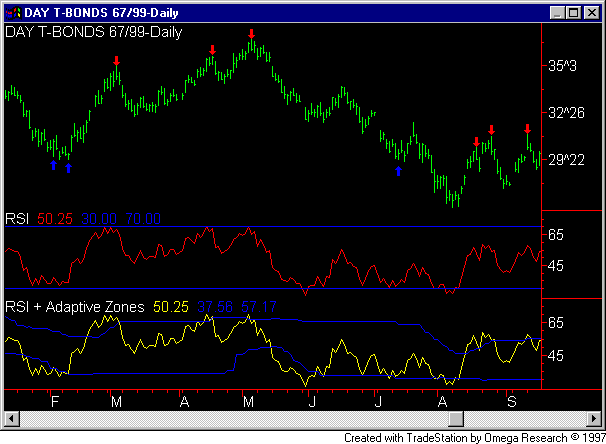
The top indicator is the canned 14 day RSI with zones of 70/30 as included with TradeStation. The bottom indicator is the same RSI but using zones that represent 12% thresholds of the recent RSI determined with a 60 day look back period. You can see that they go up and down to compensate for those extreme overbought and oversold levels that all oscillators suffer from. Marked on the chart are overbought and oversold levels that the Adaptive Zones caught which the 70/30 zones missed. There are quite a few of them!
The Complete Toolkit
The price of the complete Fractal Toolkit is $275. You get the Fractal Trend Indictor, Adaptive SlowK, Adaptive RSI, Adaptive OverBought/Sold Bands, a number of demo systems to illustrate how to profitably incorporate these tools into your own trading, and User Functions for everything so you can build your own systems! If you were to try and duplicate this toolkit by purchasing similar items from our competitors, you would have to spend over a thousand dollars and would end up with inferior products in the end. Please visit "Ordering Information" for more details.